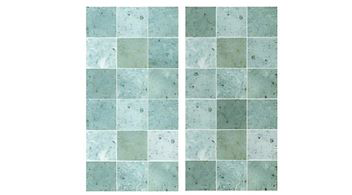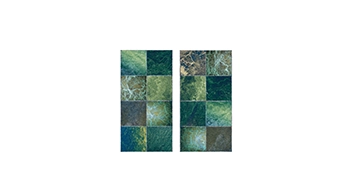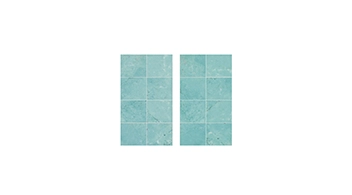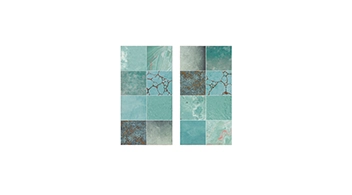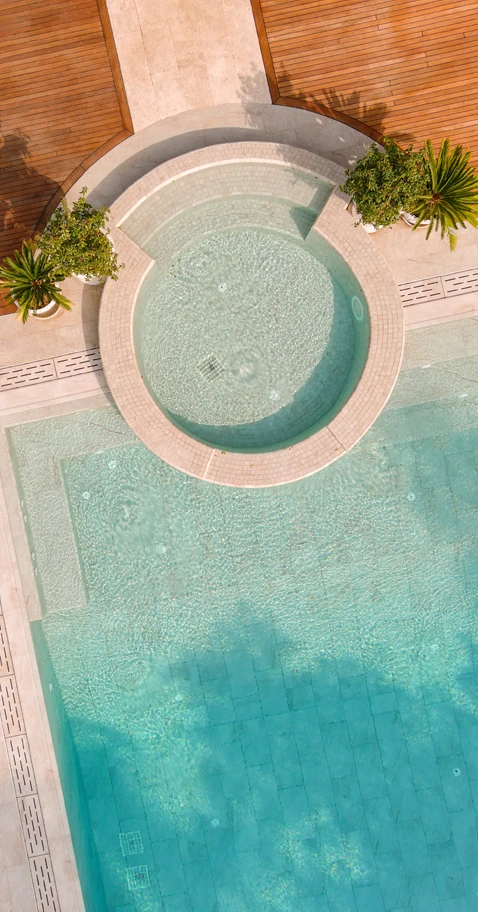
Pool design is often evaluated through large surfaces and overall form. However, the true quality of a pool is hidden in the details. Especially in projects where Porcelain Tiles are used for pool cladding, corner turns, edge finishes, and transition points are not merely aesthetic choices but technical decisions directly related to safety, durability, and long-term performance.
At this point, Inner Trim and Outer Trim are among the most critical yet least discussed components of pool architecture. Corners assumed to be solvable with flat tiles can become sources of both visual and structural problems over time. For this reason, the use of inner and outer curved elements is essential for pools.
What Are Inner and Outer Curved Pieces?
Inner Trim and Outer Trim are specially shaped structural elements used at pool corners and edge transitions to provide continuity that flat tiles cannot achieve.
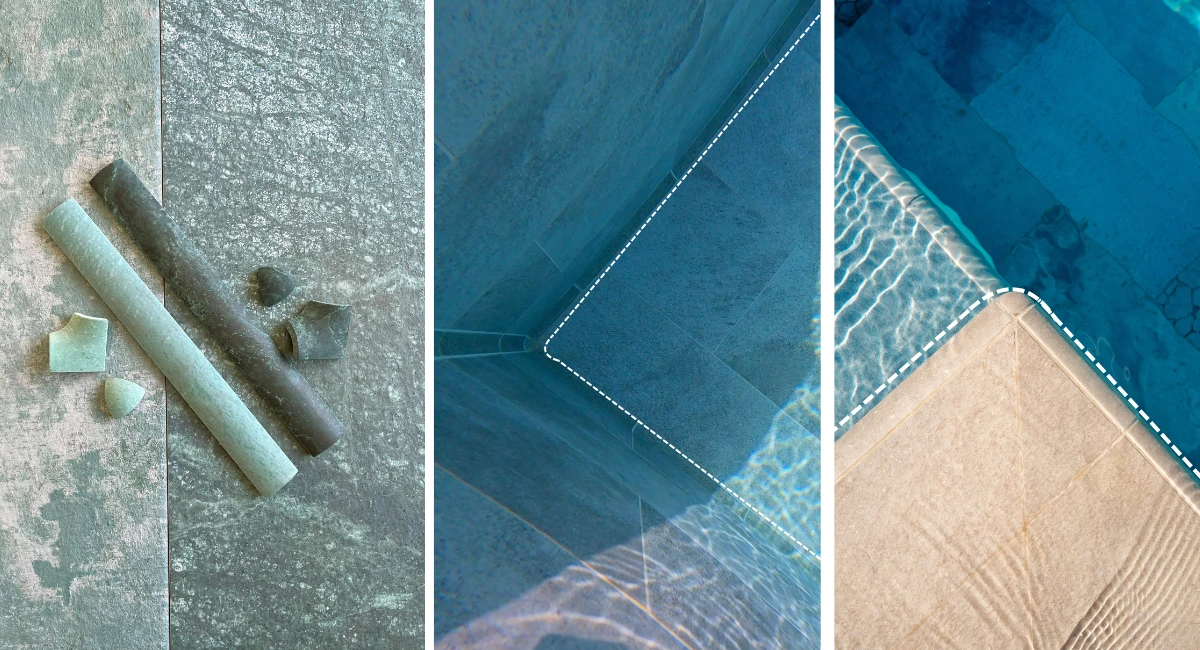
- Inner Trim are used in inward-curved transitions. They are typically preferred at pool inner corners, wall–floor junctions, and step turns.
- Outer Trim are used on outward-projecting edges, pool top finishes, around Overflow Pools, and at transition points to walking areas.
The main purpose of these pieces is to eliminate hard and sharp junctions and ensure smooth transitions between surfaces. However, their function goes far beyond this.
The Importance of Corner Details in Pool Projects
Due to their material properties, Porcelain Tiles offer high hardness and low tolerance. While this provides advantages on flat surfaces, it requires precision at corners and turning points.
Corner solutions created with flat tiles:
- Lead to sharp junctions
- Increase grout load
- Raise the risk of cracking over time
- Create difficulties in cleaning and maintenance
Inner and outer curved pieces aim to eliminate these risks at the design stage. By ensuring uninterrupted surface flow, the cladding becomes more balanced both structurally and visually.
Safer Pools with Inner and Outer Curved Pieces
Pool safety is often evaluated based on Non-slip surfaces. However, corner and edge details play an equally critical role.
Sharp corners:
- Increase the risk of injury upon foot or body contact
- May cause serious accidents when balance is lost in water
- Pose particular risks for children and elderly users
Inner Trim provide soft transitions at wall–floor junctions, preventing sudden contact with hard surfaces. Outer Trim make edge lines safer and create controlled transitions between walking areas and the pool.
More Aesthetic Pools with Inner and Outer Curved Pieces
In pool projects, aesthetics are measured not only by material quality but also by how well details are resolved. Choices made at corners and edges define the overall visual quality of the pool.
Inner and outer curved pieces:
- Ensure surface continuity
- Soften shadow and light reflections
- Make the pool form clearer and more readable
Sharp turns created with flat tiles produce a visually fragmented effect. In contrast, curved solutions allow the pool to be perceived as a single, cohesive form—especially noticeable in architectural photography and spatial experience.
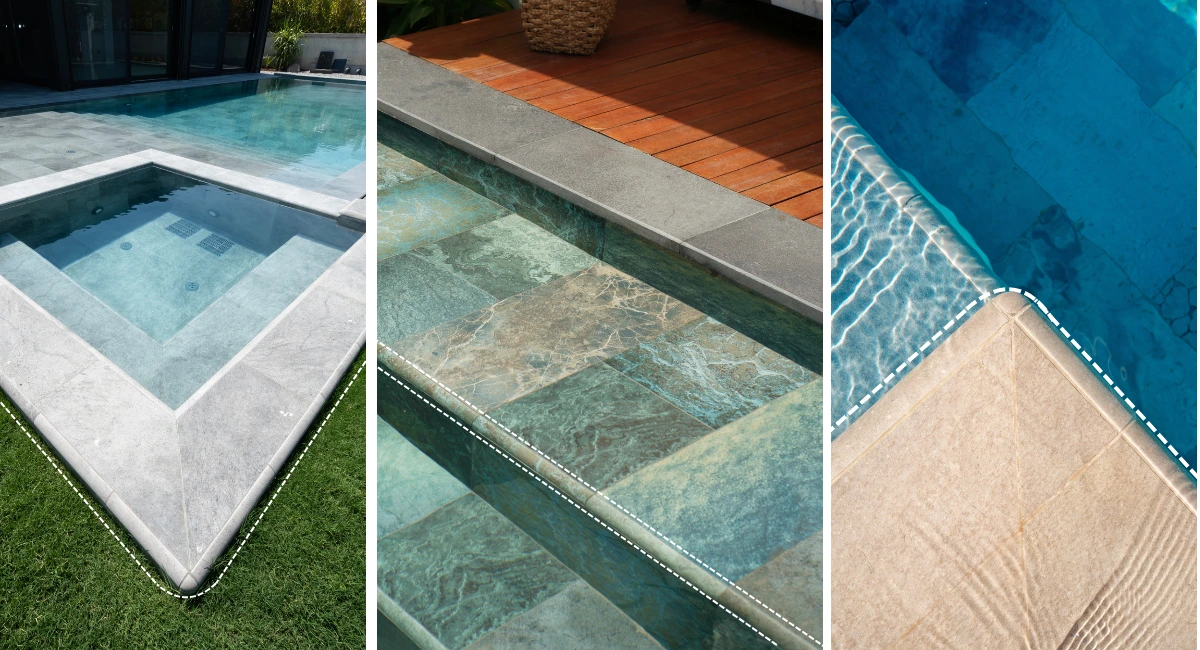
What Are the Features of Porcelain Outer Curved Pieces?
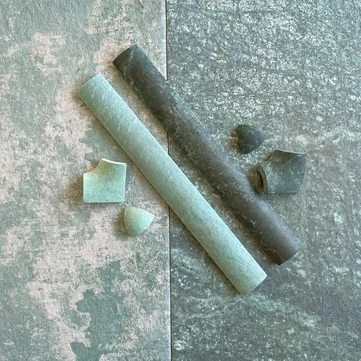
Porcelain Outer Trim are complementary structural elements designed with an outward-curved form to soften pool corner and edge transitions while maintaining surface continuity.
- Used on pool edges, turning points, and Swimming Pool Steps to reduce impact and injury risk, increasing safety in high-movement transition areas.
- Provide additional safety for children, elderly users, and high-traffic areas.
- Distribute impact on step edges, reducing hardness at contact points and creating a more Comfortable and controlled movement area.
- With a 100% porcelain body structure, they offer Low Water Absorption, enhancing durability and predictable surface behavior.
- Their non-porous surface resists bacteria, algae, and mold formation, supporting hygiene and Easy Maintenance.
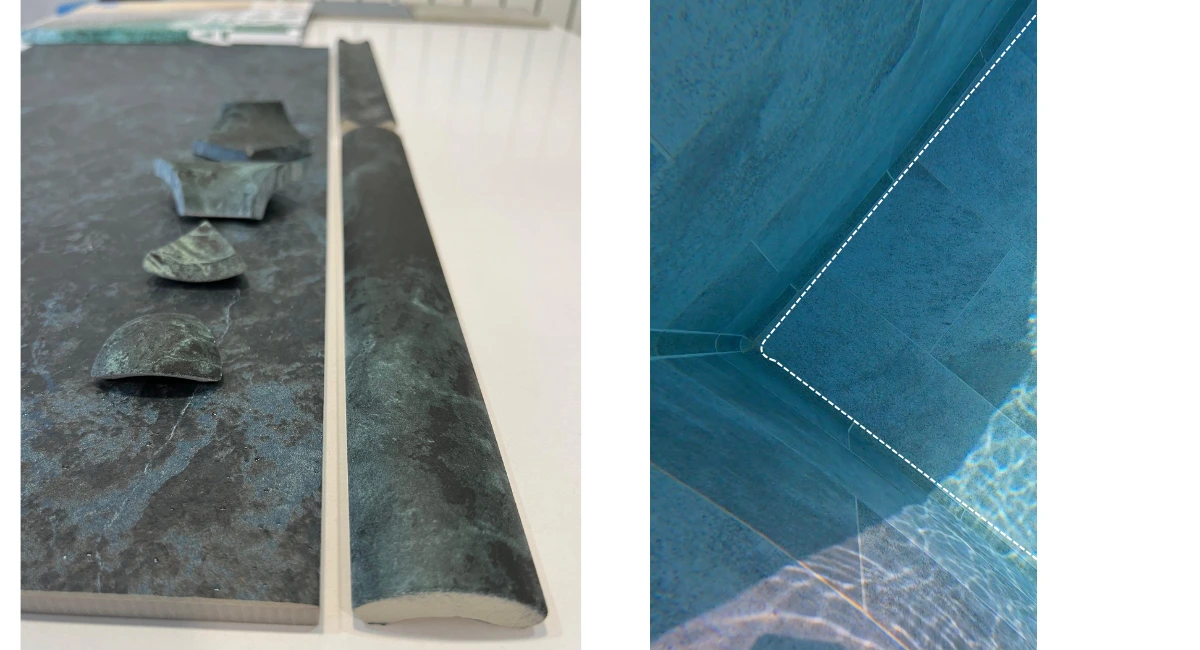
What Are the Features of Porcelain Inner Curved Pieces?
Porcelain Inner Trim are special porcelain elements with an inward-curved form, primarily used at wall–floor junctions inside pools, eliminating hard 90-degree corners.
- Soften rigid junctions to create safer and more Comfortable swimming areas.
- Prevent dirt and residue accumulation at corners, making cleaning more sustainable.
- Non-porous porcelain surfaces do not absorb water, are stain-resistant, and support long-term pool hygiene.
- Offer high resistance to UV Resistance, Chemical Resistance, and outdoor conditions, preserving color and surface integrity.
- With 4x33 cm dimensions, they provide smooth and controlled transitions at wall–floor junctions.
- Create seamless tile transitions that complete architectural integrity and enhance form continuity.
Advantages Offered by Inner and Outer Curved Pieces
Inner and outer porcelain curved pieces are not merely complementary elements but core components that ensure the proper functioning of the Pool Edge System. By eliminating sharp corners, they enhance user safety and support long-term surface durability. These elements balance grout loads, simplify maintenance, and give the pool a more fluid, readable architectural form.
Use of Curved Pieces on Pool Steps and Stairs
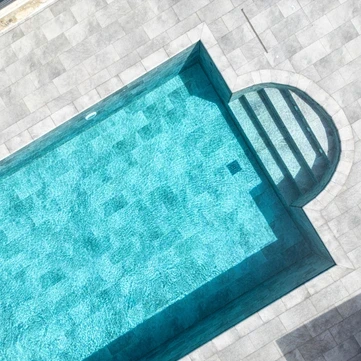
Swimming Pool Steps are among the most critical areas for the application of inner and outer curved pieces. Step front edges, turning points, and side surfaces require special attention in terms of both aesthetics and safety.
In these areas, curved pieces:
- Increase step edge visibility
- Provide more controlled foot contact
- Regulate water flow
- Indirectly reduce slipping risk
Especially in projects using Stair Non-Slip , these pieces form an integrated system where surface texture and form support each other.
Inner and outer curved pieces are often overlooked but are fundamental elements that carry the project. They do not simply complete the cladding; they ensure the system works correctly. Their placement should be evaluated within each project’s context, considering usage intensity, pool geometry, target users, and architectural language.
Frequently Asked Questions
Are inner and outer curved pieces necessary for every pool?
Not every pool has the same structural characteristics. However, in projects with corners and steps, these elements offer significant technical advantages. They should be strongly considered when safety and longevity are priorities.
Are these pieces used only for aesthetic purposes?
While their aesthetic contribution is visible, their primary functions are structural continuity, safety, and application stability. Aesthetics are the natural result of these technical benefits.
Can inner curved pieces be added later?
Theoretically possible, but not ideal. These elements should be planned during the design phase, as later additions may compromise overall integrity.